Demo video
Video coming soon
A walkthrough of the join, encounter and claim flow. The link will appear here once it is published.
Not yet available
 Levarac
ETHGlobal Tokyo 2026
Mizar and Alcor
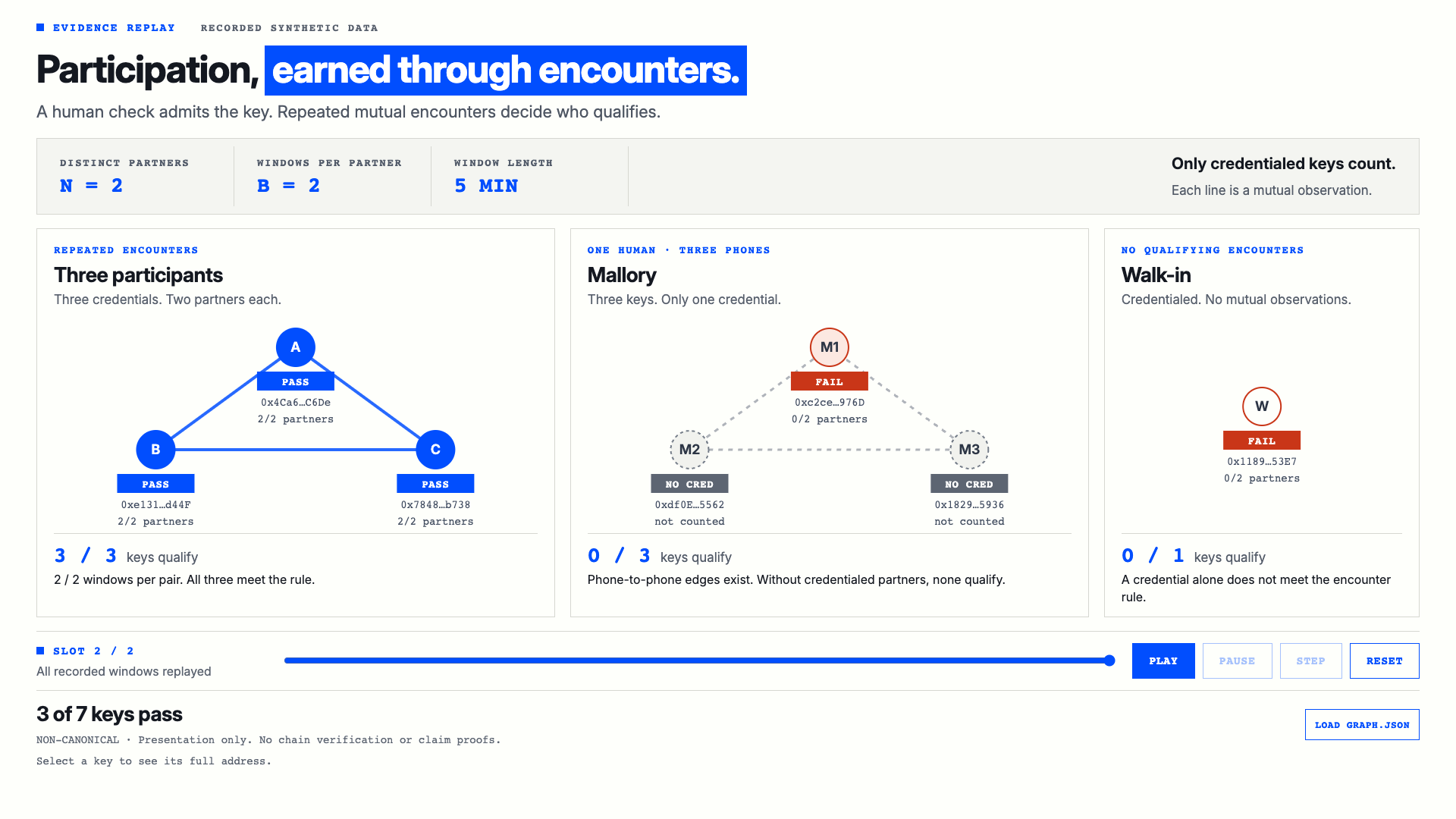
An event key qualifies when it has signed mutual observations with at least N distinct Alcor-credentialed partner keys, in at least B time windows per partner, and the claimant holds an Alcor distinct-human credential.
This proves the published rule was met under its evidence and credential trust assumptions. It does not prove physical attendance.
Try it
Demo video
A walkthrough of the join, encounter and claim flow. The link will appear here once it is published.
Not yet available
iOS app
The ETHGlobal Tokyo demo build of Beid. Beid, Levarac's reference app, implements the Parallax protocol end to end: it senses nearby devices over Barnard, signs observations with its event key and submits them for anchoring.
Join the TestFlightHuman check
Binds one World ID to an event key. The full flow needs the Beid app, which signs the check with its event key.
alcor-human-check.levarac.workers.devSepolia contract
0xC54b23Ce524ea22D41A65c2EfceEc5e483f2F0fC
EAS schema
0x858edbfff167feaa82c4bb29f3ce4a62ed06024ccdd8377f4f0b26619ccd65d3
bytes32 eventId, address eventKey, uint64 snapshotId, bytes32 manifestDigest
View on EASScanRun locally
From e2e/ in a Mizar checkout. It evaluates the fixture, posts a root on a local Anvil chain and claims against MockEAS.
pnpm install --frozen-lockfile && pnpm e2eWhat has and has not been verified live, including the claim page and the first snapshot, is kept current in the README deployment record.
How it works
01
Beid signs a typed challenge with its event key. Alcor binds one World ID to that event key for the event and publishes a signed credential.
02
Beid signs BLE observations, and Parallax anchors their commitments on Sepolia. A pair counts only when both phones report each other's rotating identifiers in the same time window.
03
Each eligible key needs N distinct credentialed partners, each seen in at least B time windows (300 s by default). The published demo parameters set N = 2 and B = 2, and were published before any snapshot.
04
The evaluator writes a manifest, the eligible list and Merkle proofs. Once a snapshot is taken, the configured root poster posts its root, the manifest's SHA-256 digest and a cutoff block to the claim contract.
05
Once a snapshot root is posted, a claim checks against it. You choose a recipient wallet and Beid signs for it. The contract checks membership and the signature, allows one claim per event key and issues a non-revocable EAS attestation. Each claim is its own transaction.
Once a snapshot root is posted, anyone with the published inputs can rerun the evaluator and compare the result with that root.
Components
Built at ETHGlobal Tokyo 2026
Pre-existing before the hackathon
Protocol for signed BLE observations and anchored evidence.
private repository
Beid, Levarac's reference app, implements the Parallax protocol end to end: it senses nearby devices over Barnard, signs observations with its event key and submits them for anchoring. Its typed event-key signing entry point was added during the hackathon.
public repository
Rule comparison
The same signed inputs, evaluated with the human check switched off, with the encounter rule switched off, and with both. Recorded synthetic data. Not live, not posted.
| Case | No human check | No encounter rule | Full rule |
|---|---|---|---|
| Honest attendees | 3 / 3 | 3 / 3 | 3 / 3 |
| Mallory: one human, three phones | 3 / 3 | 1 / 3 | 0 / 3 |
| Walk-in: credential, no encounters | 0 / 1 | 1 / 1 | 0 / 1 |
Counts are eligible event keys, not issued on-chain records. Synthetic signatures test the rule and replay mechanics; they do not establish live World ID verification, physical presence or chain anchoring. Full report and one-command reproduction.
Source
Trust assumptions
Alcor is a trusted attester: the service verifies World ID off-chain, and Mizar checks Alcor's signed credential rather than rerunning World's verification. Signed observations do not prove physical location.
Relayed or colluding devices can still manufacture encounters; the human check limits each person to one key but does not stop collusion.
What the result does and does not establish